
Differential Scanning Calorimetry

Measure the energy a material absorbs or releases as it is driven through a temperature programme — and put a defensible number on every transition it passes through.
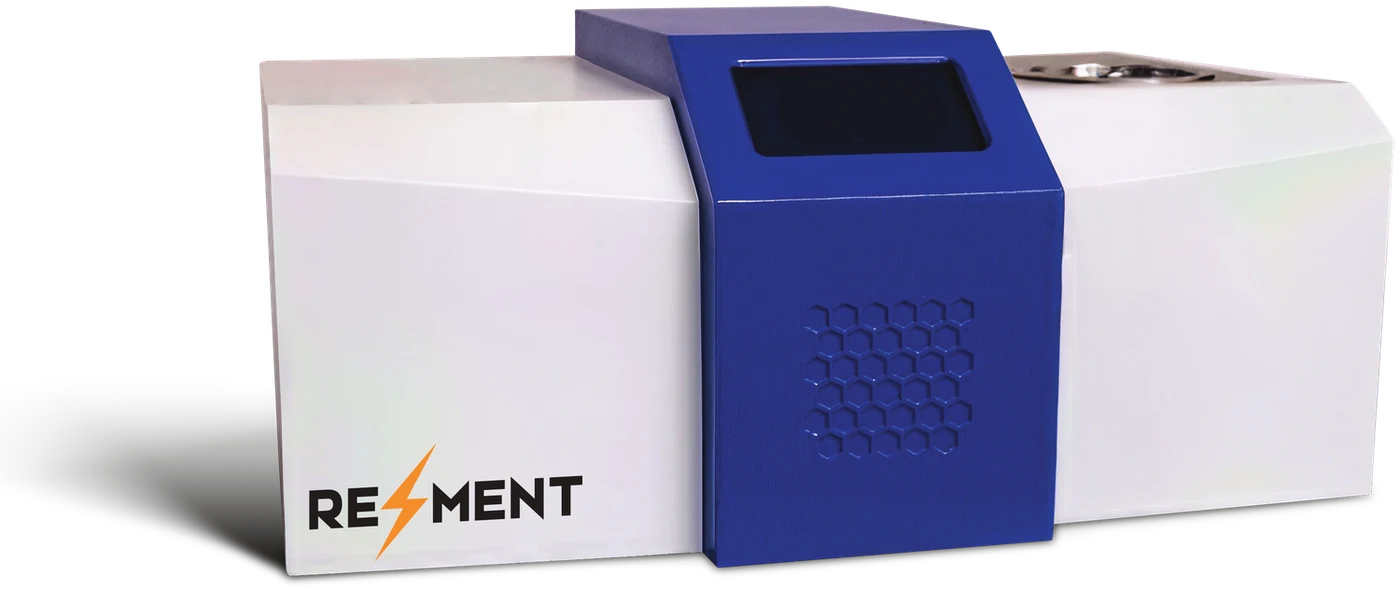
Resment DSC differential scanning calorimeter
Resment DSC-1 / 2 / 3 / 4

The workhorse of thermal characterisation

DSC answers the questions that mass alone cannot: where a polymer softens, how much crystallinity it carries, whether a drug substance has converted to a different polymorph, how long a stabilised polyolefin resists oxidation. It sees events that involve energy but no weight change — which is most of the interesting ones.

DSC-1  RT – 680 °C (opt. 1150) DSC-2  −40 – 680 °C DSC-3  −100 – 680 °C DSC-4  −100 – 680 °C auto-N₂
What it tells you

The measurements people actually buy a DSC for

Glass transitionWhere does the amorphous phase unfreeze?
Tg appears as a step in heat capacity, not a peak. It sets the practical service temperature of an amorphous or semi-crystalline polymer, reveals plasticiser content and moisture uptake, and shifts measurably as a material ages or absorbs solvent.
Melting & enthalpyHow much crystalline order is in there?
The melting endotherm gives Tm; the area under it gives the enthalpy of fusion. Ratioed against the literature value for the fully crystalline polymer, that enthalpy becomes a percentage crystallinity — a number that correlates directly with stiffness, barrier properties and dimensional stability.
PolymorphismIs this the same solid form you qualified?
Polymorphs of a drug substance melt at different temperatures with different enthalpies, and frequently interconvert on heating. DSC resolves the form present, catches metastable transitions, and is the standard first screen for drug–excipient compatibility.
CrystallisationHow does it behave on the way down?
Cooling and isothermal experiments give crystallisation onset, peak and kinetics — how fast a melt sets, whether a nucleating agent is working, and what a moulding process will actually produce at a given cooling rate.
Oxidation inductionHow long before the stabiliser gives out?
Held isothermally under oxygen, a stabilised polyolefin resists oxidation for a measurable induction period before the exotherm breaks. OIT is the accepted comparative measure of antioxidant performance in cable compounds, pipe grades and geomembranes.
Purity & heat capacityHow pure is it, and what will it take to heat it?
Melting-point depression yields purity for suitable crystalline substances, and a sapphire-referenced run yields specific heat capacity — the input a process engineer needs to size heating and cooling for a real vessel.
How the measurement works

Two pans, one programme, one difference

A DSC holds your specimen and an empty reference pan on a symmetric sensor inside a single furnace, and drives both through the same temperature programme. When the sample melts, crystallises or changes heat capacity, the heat flow needed to keep it tracking the reference changes — and that difference, plotted against temperature, is the thermogram.

Furnace — single controlled temperature programme Sample your material Reference empty pan Differential heat flow ΔQ measured between the two pans Purge gas Exhaust
Fig. 1 — DSC measurement principle. Because the measurement is differential, almost every design decision in the instrument exists to make the two sides identical apart from the sample: furnace symmetry, sensor matching, a stable purge, and calibration against certified standards.

This is also why the unglamorous specifications matter more than the headline temperature range. A furnace and control unit built as one assembly keeps signal paths short and rejects external interference. Dual mass-flow-controlled purge lines keep the atmosphere — and therefore the baseline — reproducible from run to run. Calibration against indium, tin, lead, zinc and aluminium standards anchors the temperature axis to physical constants rather than to a factory setting that will drift.

Reading the result

What a trained eye takes from the trace

A single run across a semi-crystalline polymer contains three separate pieces of information, in the order the material gives them up.

50 100 150 200 250 300 Temperature (°C) Heat flow (mW) exo Glass transition (Tg) step change in heat capacity Crystallisation (Tc) exothermic — energy released Melting (Tm) peak area = enthalpy of fusion ΔH 10 K·min⁻¹, N₂ purge
Fig. 2 — Schematic DSC thermogram, exotherm up. Note that the glass transition is a step, not a peak — it is a change in heat capacity rather than a latent heat, which is why it is the feature most often lost to a noisy baseline.
Technical data

Specifications

Four models share a common platform and differ principally in how low they can go — ambient, mechanically refrigerated, or nitrogen-cooled.

Temperature
Temperature range DSC-1  RT – 680 °C (optional 1150 °C)
DSC-2  −40 – 680 °C (mechanical refrigeration)
DSC-3  −100 – 680 °C (manual N₂ feed)
DSC-4  −100 – 680 °C (automatic N₂ feed)
Temperature accuracy±0.1 °C
Repeatability±0.1 °C
Heating rate0.1 – 100 °C/min
Calorimetry
Measurement range±500 mW
Minimum resolution±0.1 µW
Temperature controlHeating thermostat, programme-automatic
Gas flow10 – 200 mL/min
Crucibles & calibration
Sample pansCeramic 0.06 mL  ·  Aluminium 0.06 mL  ·  Platinum 0.06 mL
Sealed aluminium crucible 30 µL  ·  Sealed stainless-steel high-pressure crucible 30 µL
Temperature correctionIntelligent, freely selectable baseline correction against certified standards — indium, tin, lead, zinc and aluminium. User-correctable.
SoftwareEnthalpy, glass transition, oxidation induction time, melting point and specific heat routines, with automated report generation. Optional coupling to gas chromatography and mass spectrometry.

Figures correspond to the current Resment DSC datasheet. Confirm the exact configuration and accessory set at the time of quotation.

Accessories

Cooling and sample preparation

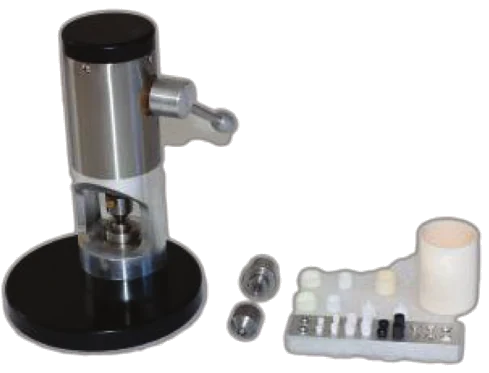
Crucible sealing press and pan set

Crucible sealing press

Hermetic and standard pan sealing, with the crucible set matched to your sample type.
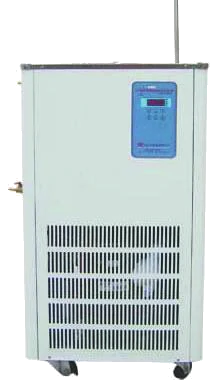
Mechanical refrigeration unit

Mechanical refrigeration

Sub-ambient operation to −40 °C without consumable cryogen. Supplied with DSC-2.
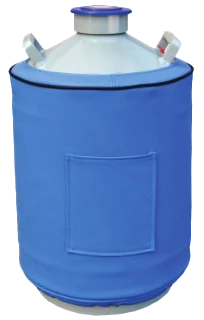
Liquid nitrogen dewar

Liquid nitrogen cooling

Reaches −100 °C for low-temperature transitions. Manual feed on DSC-3, automatic on DSC-4.

Not sure which model fits?

The choice usually comes down to how far below ambient you need to go, and whether you can live with consumable nitrogen. Tell us your samples and we will tell you plainly.

Ask an application question