Simultaneous Thermal Analysis

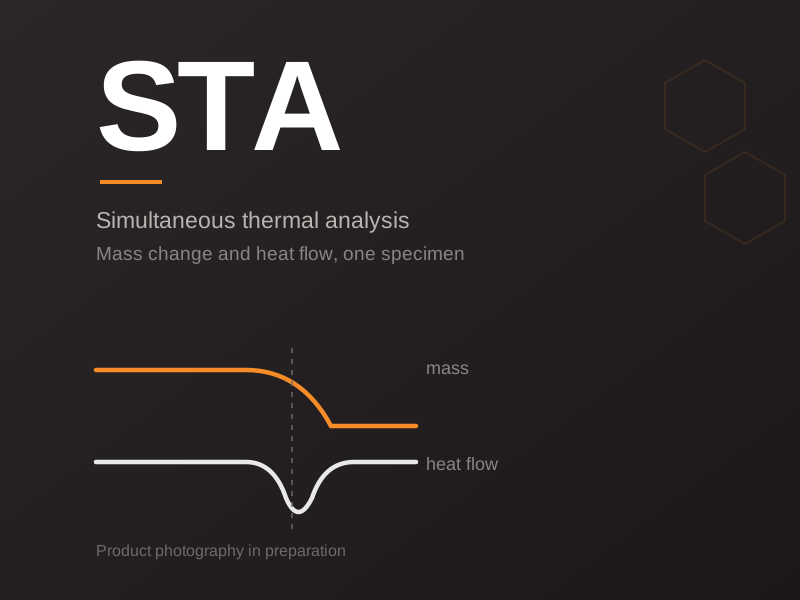
Mass and heat flow, recorded from one specimen in one run — because an endotherm on its own does not tell you what happened.
Resment STA simultaneous thermal analyser
Resment STA series

One specimen, two signals, no ambiguity

Run a DSC and a TGA separately and you are comparing two specimens, two thermal histories and two baselines. Where the events overlap — and in decomposing, dehydrating or reacting systems they usually do — that comparison stops being safe. An STA removes the variable by measuring both on the same few milligrams under the same ramp.

Detailed photography and the model-specific datasheet for this line are being finalised — please request certified specifications with your enquiry.

Why simultaneous

The interpretation problem STA solves

Consider a sharp endotherm at 380 °C. On a DSC trace alone it could be a melt, a solid–solid transition, a dehydration or the onset of decomposition — and the four have very different consequences for your process. Overlay the mass signal and the question answers itself.

60 80 100 Mass (%) 100 200 300 400 500 600 Temperature (°C) Heat flow (mW) Endotherm, mass unchanged → a melt Endotherm with mass loss → decomposition Both signals, one sample, one run
Fig. 1 — Schematic simultaneous measurement. The first endotherm occurs with the mass trace flat — nothing left the crucible, so it is a melt. The second coincides with a mass-loss step, so it is decomposition. Vertical alignment between the two panels is the whole argument for the technique.
What it tells you

Where the combined signal is worth the instrument

Event identificationMelt, transition, dehydration or decomposition?
The presence or absence of a coincident mass change is usually decisive. This is the single most common reason laboratories move from separate instruments to a simultaneous one.
Reaction chemistryWhat energy accompanies each mass loss?
Dehydration, decarbonation, oxidation and reduction each have a characteristic enthalpy as well as a stoichiometric mass change. Having both from one run lets you check the two against each other rather than assume.
Scarce samplesHow do I get both measurements from this much material?
Where the specimen is precious, inhomogeneous or simply tiny — a single crystal batch, a failure fragment, a pilot-scale synthesis — a simultaneous run avoids splitting it and avoids the sampling error that splitting introduces.
Ceramics & mineralsWhat happens through sintering?
Binder burn-out, carbonate decomposition, phase transformation and sintering shrinkage occur across one long ramp. Following mass and energy together through that sequence is standard practice in ceramic and refractory development.
Technical data

Indicative specifications

The figures below are representative of this class of simultaneous TGA–DSC instrument and are pending confirmation against the model-specific datasheet. Please request certified values with your enquiry.
Temperature — indicative
Temperature rangeRT – ~1500 °C (model-dependent)
Temperature accuracy±0.1 °C (indicative)
Heating rate0.1 – 100 °C/min (indicative)
Signals — indicative
Balance resolution0.01 mg (indicative)
DSC range / resolution±500 mW  ·  ±0.1 µW (indicative)
AtmosphereInert, oxidising or reducing; static or dynamic switching

Tell us what you need to distinguish.

Describe the sample and the event you are chasing, and we will confirm certified specifications and the right configuration.

Request certified specifications