
Thermogravimetric Analysis
Weigh a specimen continuously while you heat it, and the temperature at which each fraction departs tells you what the material was made of.
Composition, resolved by temperature
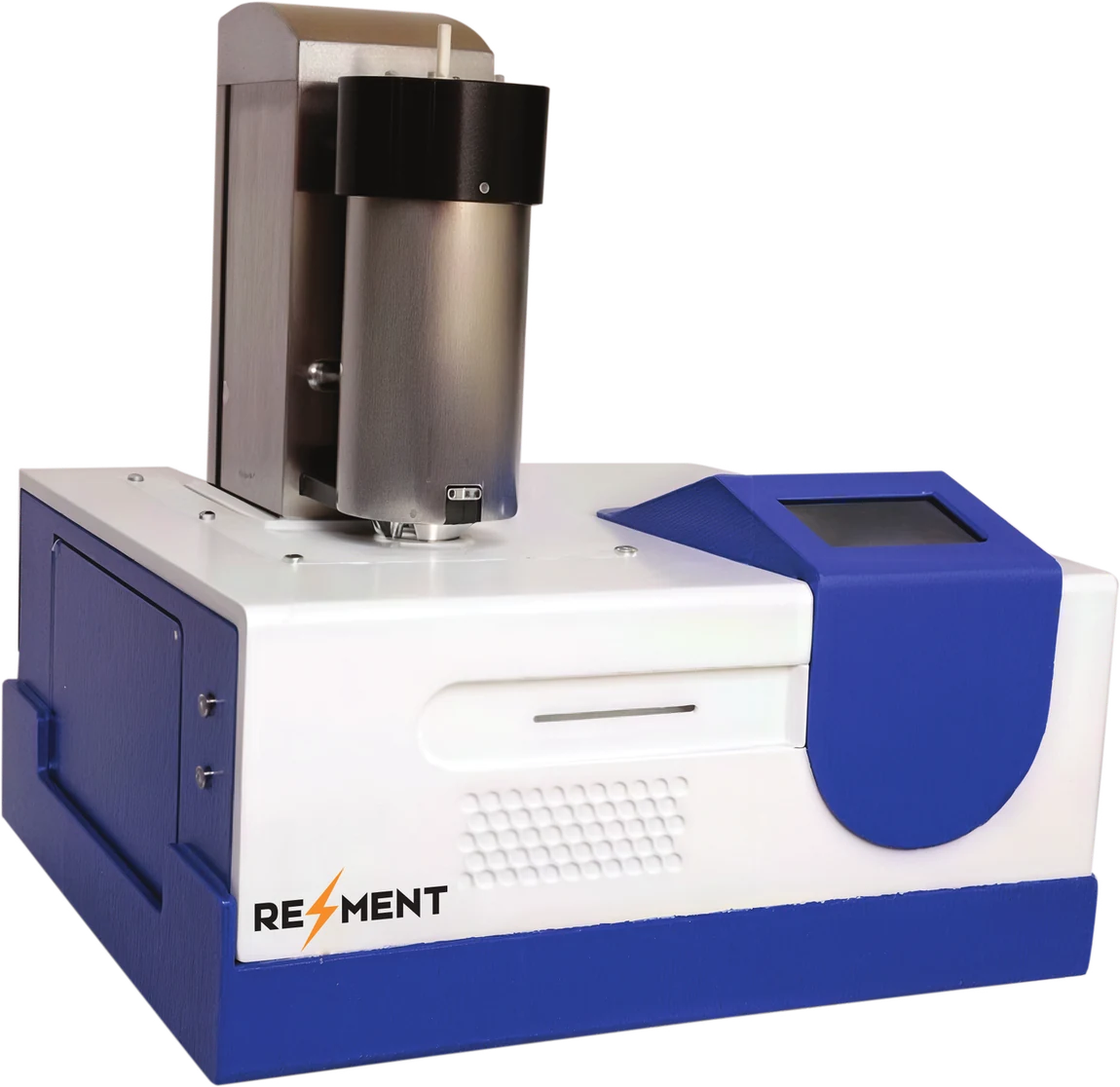
A thermobalance turns a heating ramp into a compositional assay. Water leaves first, then plasticiser and other volatiles, then the polymer backbone decomposes, and what survives to the top of the ramp is filler, ash or char. Read the steps and you have quantified a formulation without dissolving a thing.
The questions a thermobalance settles
The derivative is where the detail lives
A TG trace shows how much mass was lost. Its first derivative — the DTG curve — shows when, and separates overlapping events that the mass curve alone smears into a single slope. Two decomposition processes a few tens of degrees apart appear as one long step in TG and as two clean peaks in DTG.
Getting that resolution out of a real sample depends on things that never appear in a headline specification: a furnace that lifts and lowers to a repeatable position so the buoyancy correction stays valid, a three-way valve that switches atmosphere without a pressure transient, and a balance quiet enough that a 0.1 µg feature is signal rather than noise.
Specifications
The four models share one thermobalance and differ in furnace ceiling — from 1150 °C for polymers and pharmaceuticals up to 1550 °C for ceramics, refractories and mineral work.
| Temperature range |
TGA-1 RT – 1150 °C TGA-2 RT – 1250 °C TGA-3 RT – 1450 °C TGA-4 RT – 1550 °C |
|---|---|
| Temperature accuracy | ±0.1 °C |
| Heating rate | 0.1 – 100 °C/min |
| Furnace | Controlled automatic lifting, repeatable positioning |
| Measurement range | 1 – 200 mg (customisable to 5 g) |
|---|---|
| Resolution | 0.1 µg |
| Thermogravimetric noise | < 0.1 µg |
| Vacuum | 2.5 × 10⁻² Pa (with vacuum unit) |
| Atmosphere system | Flow controller with three-way valve for stable switching between inert, oxidising and reducing gas |
|---|---|
| Thermostatic control system | RT – 400 °C transfer line · TGA-GC, TGA-MS, TGA-FTIR |
| Sample pans | Ceramic 0.06 mL / 0.12 mL · Platinum 0.06 mL |
| Analysis | TG / DTG / DDTG with user-definable calculations, screenshot capture and automatic signal-range adjustment |
Figures correspond to the current Resment TGA datasheet. Confirm the exact configuration and accessory set at the time of quotation.
Where TGA earns its place
Need the mass loss and the thermal event together?
If you are trying to tell a melt from a decomposition, a simultaneous thermal analyser records both signals on the same specimen in one run.